Document type: Report on consultative mission no. 24115 published by the French Ministry of Agriculture, Agri-Food, and Food Sovereignty
Authors: Véronique Bellemain, Arnaud Martrenchar
Summary: The FRCAW was established in 2017 as the result of a provision of the 2014 Law on the Future of Agriculture in France. Its funding is provided by its member organizations, foremost among which is INRAE, the appointed legal entity under which the FRCAW operates, and through annually agreed financial support from the French Ministry of Agriculture. As part of the renewal of the Centre's founding agreement, the Ministry requested an appraisal of work carried out, and proposals, should these be required, for changes to the organizational structure to better address current challenges and the expectations of the Centre's various target audiences.
The task force reviewed the various outputs of the FRCAW since 2017 and consulted with more than forty organizations: overseeing authorities, the Centre's member organizations (through their boards and representatives to the FRCAW), the permanent staff, professional organizations (relating to farm animals and companion animals, the veterinary profession), animal welfare associations, etc.
The FRCAW was established through a framework agreement for an initial five-year term (2017–2021), and this was renewed in 2022 (2022–2026).
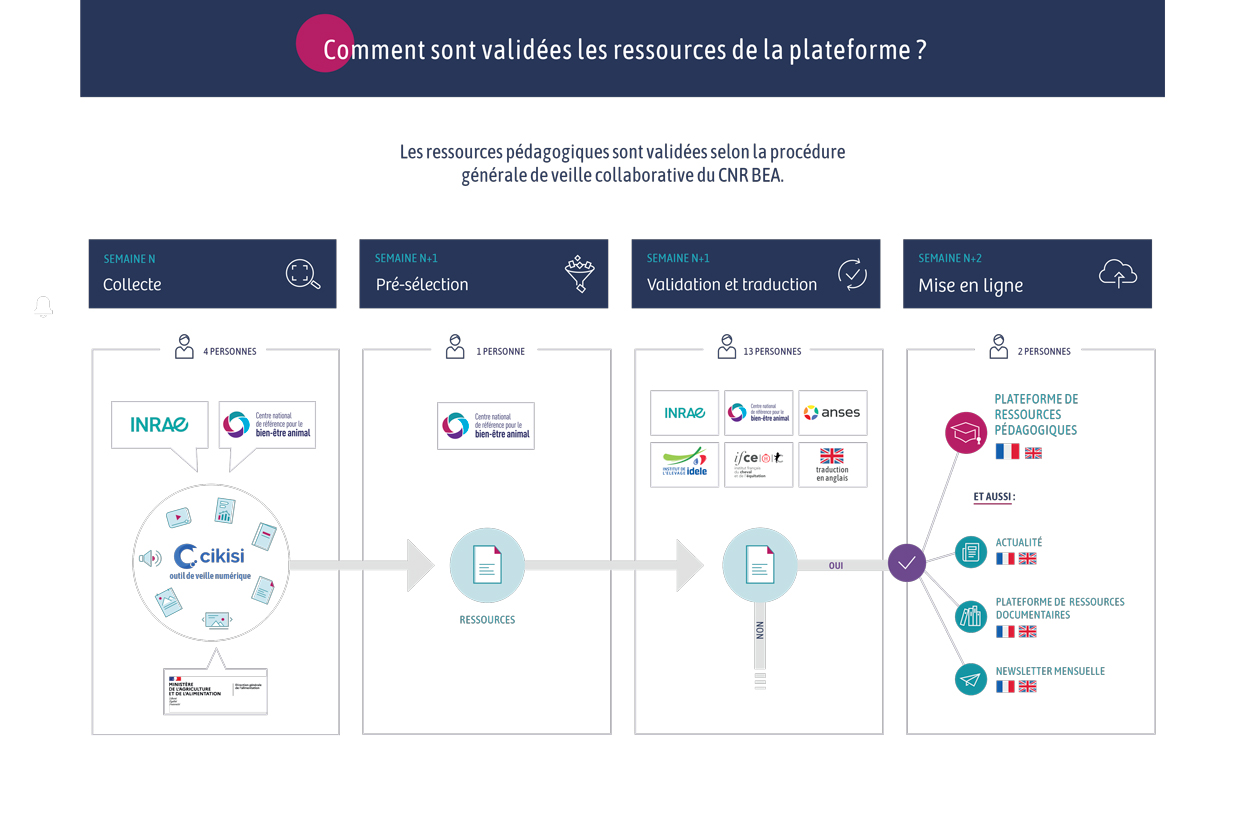
Its primary mission is to provide scientific and technical support to the French Ministry of Agriculture for the development of public policy, as well as to all professional stakeholders, particularly livestock farmers. It contributes to the dissemination of information through resource platforms and a newsletter. It has also been designated as the expert body for the Observatory for the Protection of Domestic Carnivores (OCAD), established in 2021. In addition, it maintains ties with the European Union Reference Centres for Animal Welfare and the National Reference Centres of six other Member States.
Having no legal status of its own, the FRCAW is managed by INRAE. It is funded by its members and an annual grant from the Ministry of Agriculture (€246,500 in 2024). In 2025, the permanent staff consisted of two INRAE employees and four employees on fixed-term contracts. It uses the services of a network of experts as required by the referrals it receives.
In 2025, the Centre had attained a certain level of maturity. The permanent staff and member representatives on the steering committee are highly engaged and generally satisfied with the work accomplished.
With regard to target audiences, perceptions of the relevance of the FRCAW greatly depend on who is asked.
The Centre provides indispensable scientific support for the DGAL, which nevertheless has a critical need for technical and economic expertise (on feasibility, impacts, etc.) to complement the animal-centered expertise currently provided. For animal welfare organizations, it acts as a valuable reference tool. Conversely, professional agricultural organizations criticize the animal-centered approach which, coupled with a lack of understanding of the economic and technical realities, leads to opinions that are cut off from the reality on the ground, of no utility, and even harmful as the consequence of the errors they convey.
The report proposes that the FRCAW's convention should be renewed, while making recommendations to reform its governance and operations: reviewing its strategic management, replacing the advisory committee with briefing meetings, changing the functions of staff, securing the long-term employment of certain personnel through long-term scientific assignment contracts, etc.
It is also recommended that an independent unit be created within the FRCAW to assess the impacts of certain measures resulting from animal-centred opinions. Last, it is essential to restore genuine trust with professional organizations.
Download the report (PDF)