Foie Gras Production: A Literature Review on the Welfare Implications of Force-Feeding of Ducks
Foie gras production is based on the force-feeding (gavage) of waterfowl to induce hepatic steatosis and subsequent liver enlargement.

What we do
The FRCAW brings together top professionals in research, development and training in order to enhance and disseminate knowledge, innovation and know-how, thereby facilitating the integration of animal welfare into the design of sustainable farming systems, and to bring together all stakeholders involved in animal welfare. Its creation is one of the major actions set out in France's animal welfare strategy (2016-2020).
Legally provided for in the French Future Agriculture legislation and created in 2017 by the French Ministry of Agriculture and Food, the French Reference Centre for Animal Welfare (FRCAW) provides collective expertise and consolidated scientific and technical references to public authorities and economic and social actors in order to improve the consideration of the welfare of animals under human care (farm animals, pets, captive wildlife...).
(1) Law n°2014-1070, 13 October 2014, article 41
Our aim
The main objective of the FRCAW is to support all stakeholders in the animal sector in improving their practices to take better account of the welfare of animals under human care, while providing a technical-scientific reference framework to facilitate dialogue between stakeholders.
Our work falls into three areas.
Our partners are public, private and voluntary organisations involved in animal welfare.

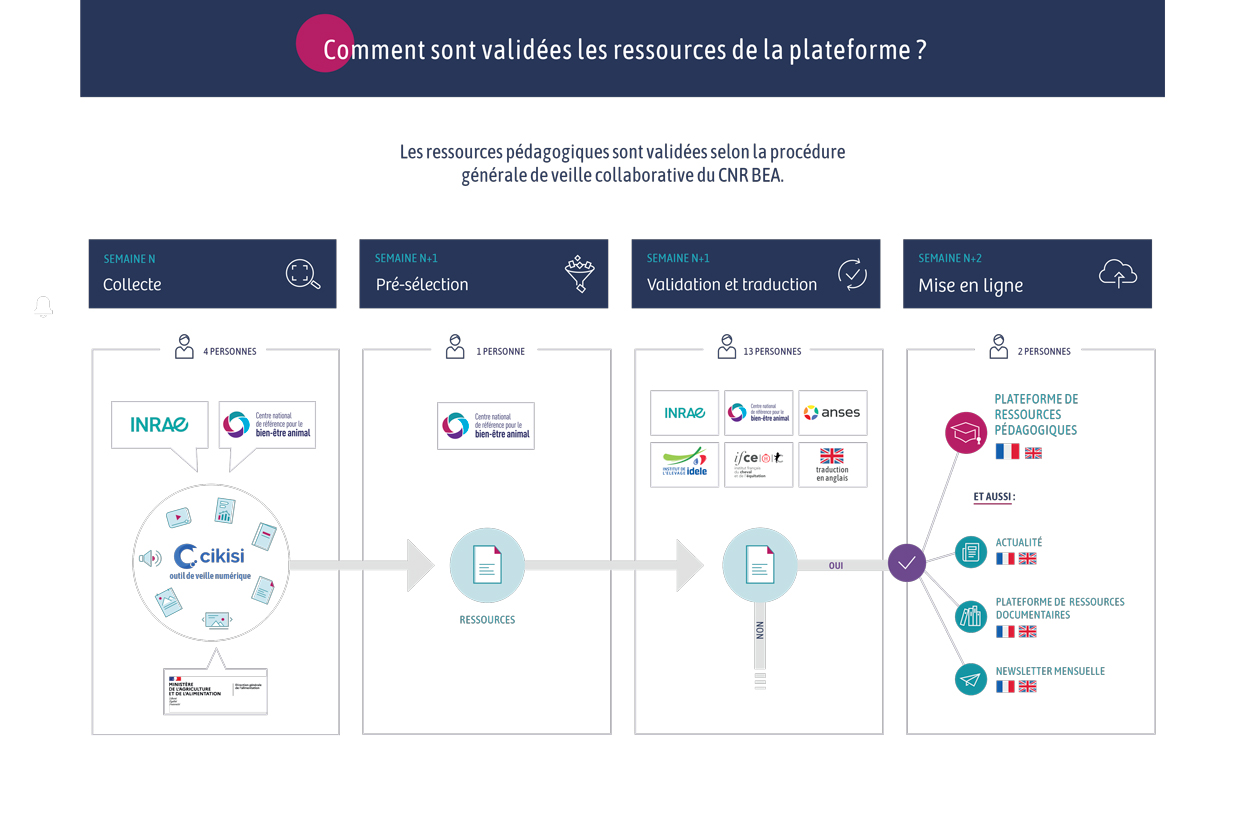
To meet the objective of the French National Animal Welfare Strategy's Pillar 1 ("Sharing knowledge and promoting innovation"), FRCAW collects, consolidates and promotes knowledge and reference information from a range of sources:
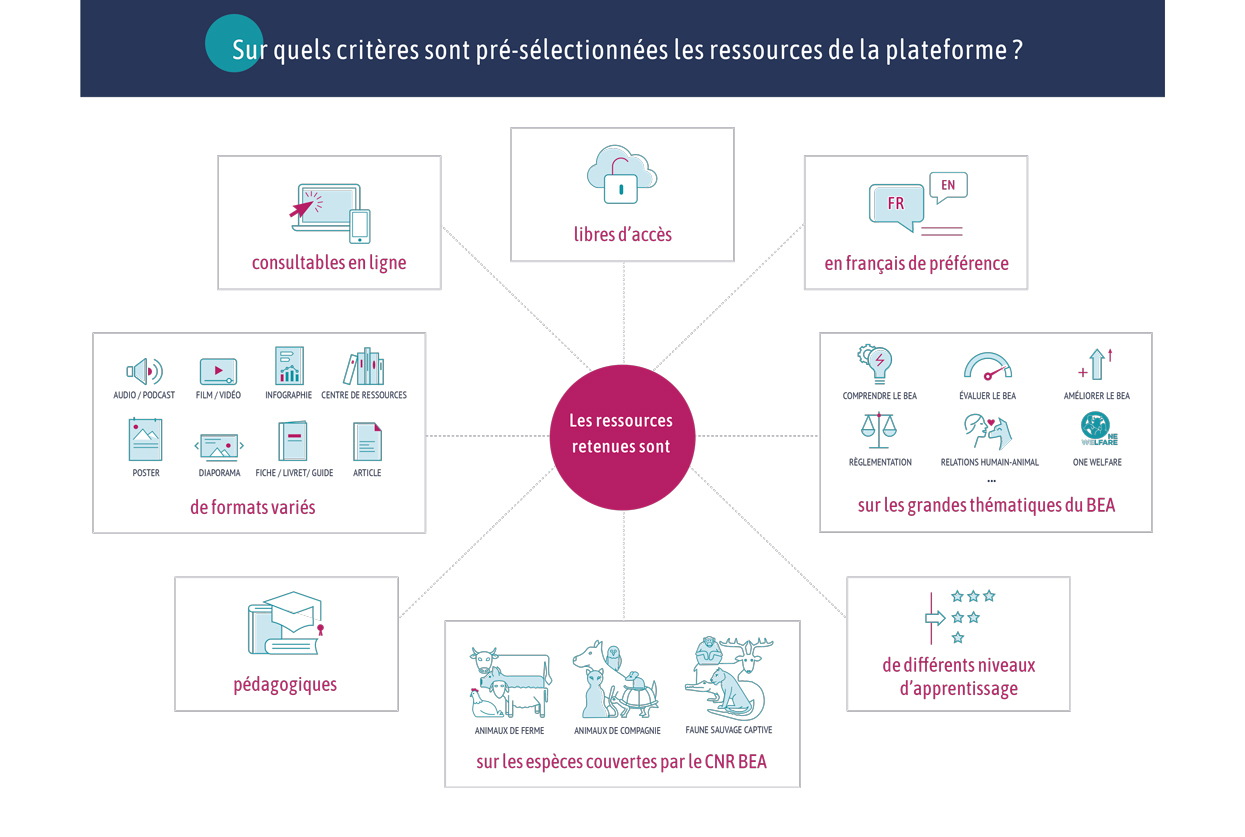
An open-source participatory documentation and information platform and a welfare joint-monitoring service are available on this website.
The information provided, which is freely accessible, is intended mainly for professionals working in the livestock and animal sectors (professional breeders and animal keepers, professionals from the transport, abattoir and agri-food sectors) and those who support them (technicians, advisers, veterinarians and veterinary technicians, engineers, consultants, etc.).
It is also intended for anybody involved in animal welfare: public officials and authorities, stakeholders, researchers and teachers in the agricultural, agronomy and veterinary sectors, representatives of animal welfare NGOs, etc.

The purpose of the FRCAW is to provide scientific and technical expertise to public authorities, partner organisations and the various organisations involved in animal welfare, based on the current state of knowledge.
To this end, FRCAW has developed and coordinates a network of qualified scientific and technical experts.
Also, the FRCAW, with its partners, provides new research to benefit the public interest, having identified gaps in existing knowledge and translated these into research questions.
In order to put the skills developed in France to best use, the FRCAW operates within the framework of the European network of reference centres on animal welfare (made up of both national reference centres in the different Member States of the European Union and of species-specific European reference centres on animal welfare).

The Chair of Animal Welfare works alongside the FRCAW in its mission to provide a training resource centre that:
This mission encompasses higher education (veterinarians and agricultural engineers), vocational training (veterinary practitioners and veterinary inspectors, abattoir staff, livestock stakeholders, etc.) and continuing professional development.
The Chair of Animal Welfare
The creation of the Chair of Animal Welfare is part of France's strategy for animal welfare (2016-2020) produced by the French Ministry of Agriculture. The partnership chair is hosted by VetAgro Sup (Lyon veterinary campus and ENSV, the French national veterinary services professional training institution) and is supported by the Ministry's animal health and protection unit (DGAL).
 Foie Gras Production: A Literature Review on the Welfare Implications of Force-Feeding of Ducks
 Sustainable livestock farming that respects animal health and welfare
 Review: How Do We Measure Animal Welfare on Farms? Indicators, Proxies, and Gold Standards


Site map - Legal information - Privacy - Cookies - Accessibility - Design and production Numéria Communication